
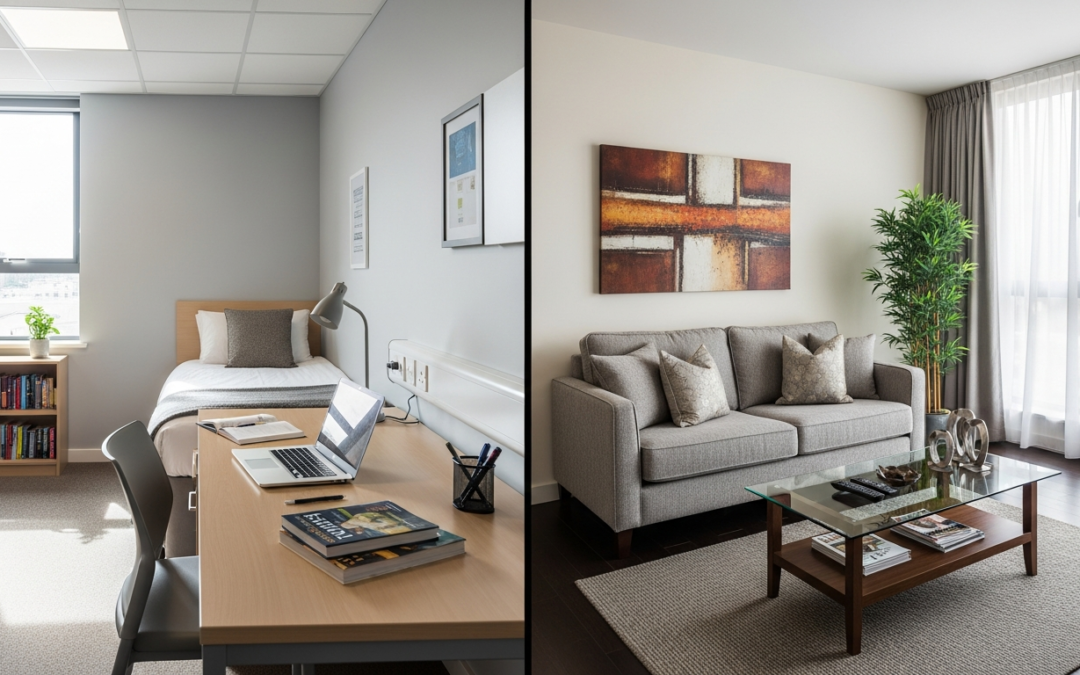
Accommodation is the second-largest line item for international students after tuition, and the line item with the widest variance between best-case and worst-case outcomes. The same student in the same city can pay between GBP 600 and GBP 1,800 per month for housing depending on whether they secure a university hall spot, book a purpose-built student accommodation early, take a private rental with flatmates, or arrive without a booking.
Indian students who secure accommodation before arrival save an average of GBP 1,200 to GBP 2,400 per year on first-year housing costs, primarily by avoiding the premium that last-minute lets command. The recommended booking window is 60 to 90 days before arrival for most destinations, with the USA requiring 3 to 6 months for off-campus housing in major cities.
Four accommodation types are realistic for international students: university halls of residence, purpose-built student accommodation, private rentals, and homestays. University halls provide the best social integration for first-year students, PBSA offers the best amenities for the price, private rentals with flatmates offer the most independence and the lowest per-person cost, and homestays are excellent for cultural orientation but cost 15 to 25 percent more than shared private rentals.
The hidden costs add 15 to 30 percent to the headline rent depending on the destination. UK TV licence at GBP 169 per year, Germany GEZ broadcasting fee at EUR 18.36 per month, Netherlands energy deposit, Australia bond (four weeks rent, refundable), and US broker fees and furniture setup costs can all surprise Indian families who budget only for the headline rent.
Indian students should always read the tenancy agreement in full before signing, photograph the property condition at move-in, and keep written records of all landlord communications. Uniassure’s arrival support includes a tenancy-rights briefing tailored to the destination country and a pre-vetted housing network offering 8 to 14 percent below prevailing market rate through group booking arrangements.
For Indian students who arrive at the destination without pre-booked accommodation, the first 30 to 60 days typically cost 30 to 50 percent more than planned, as the supply of available short-term lets is thin and the operators of those lets price for the urgency. The right strategy is to book at least the first 4 weeks of accommodation before departure, ideally at a PBSA that allows extension into a longer contract once the student is on the ground and has seen the local options in person.
Family communication is the third critical operational detail. Indian parents often book accommodation from India based on photos and online descriptions, but the right unit can vary dramatically based on factors the family cannot assess from abroad: noise level from nearby nightlife, distance from the actual academic building rather than the postal address, and the social composition of the PBSA. Uniassure scholars receive a parent briefing with the right questions to ask the housing provider before signing, and the option for a senior scholar already on the ground to visit the shortlist before final commitment.
For the second year and beyond, the right accommodation strategy is to identify a 12-month rental with two or three flatmates from the same university course, signed before the end of the first year. The cost is typically 15 to 25 percent below comparable PBSA, the social integration is strong, and the longer contract removes the annual re-application stress that characterises PBSA and most UK halls.
You might also like: Accommodation Guide for International Students 2026, Cost of Studying Abroad 2026, Living Costs Abroad 2026. Related article: Living Costs Abroad Budget Guide 2026. Explore Uniassure pathways: Value-Added Courses, UA Assurance. Sources: UKCISA, Study in Europe.
Written by: Uniassure Academic Intelligence Team
Reviewed by: Uniassure Content Excellence Committee
Strategic Oversight: Vikram S. & Gurinder S., Uniassure Founders