
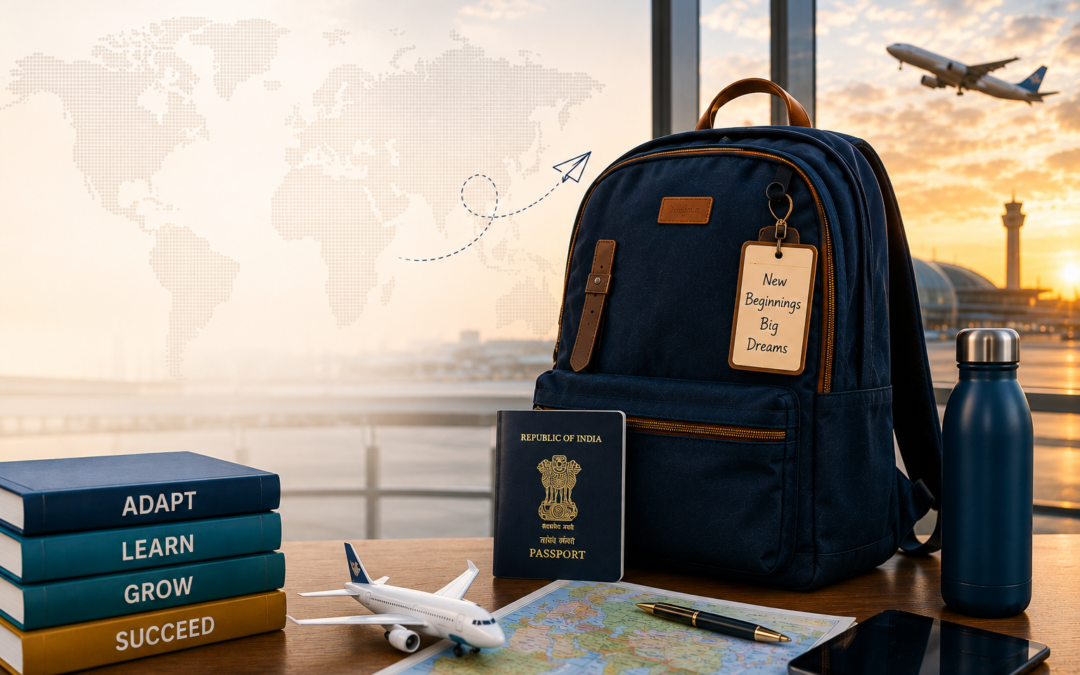
Student transition support for international students should begin the day you accept your offer — not the day you land at Heathrow, Sydney, Toronto, or New York. The period between accepting your offer and walking into your first lecture is packed with critical tasks that, if missed, can derail your arrival and create unnecessary stress. This detailed checklist covers every step you need to take, organised by timeline, with specific guidance for each destination.
AI Summary
- Start transition preparation 3 months before departure — visa alone takes 4-12 weeks depending on destination
- Open international bank account and book accommodation 2 months before flying
- Complete health preparations and pack essentials 3-4 weeks before departure
- Set up digital infrastructure (SIM, apps, university portals) 2 weeks before flying
- Comprehensive student transition support for international students reduces settlement time by up to 50% and prevents common arrival problems
Visa and Documents: The Critical Path
Your visa application is the most time-sensitive task on the entire checklist. Processing times vary significantly by destination and season. UK student visas from India take 3 to 6 weeks during peak season (July-September). Australian student visas average 4 to 8 weeks. Canadian study permits can take 8 to 12 weeks or longer. Apply the moment you receive your CAS (Confirmation of Acceptance for Studies), CoE (Confirmation of Enrolment), or equivalent document from your university.
Essential documents in original form (carry in hand luggage): passport with valid visa vignette, university offer letter and CAS/CoE, academic transcripts and certificates from all previous education, English language test score report (IELTS/TOEFL/PTE Academic), tuberculosis test results (mandatory for UK and Australian visa applications and may be checked at immigration), financial documents (bank statements, education loan sanction letter, or scholarship award letter showing sufficient funds for tuition and living costs).
Documents to carry as certified copies in checked luggage: additional passport-sized photographs, driving licence if you have one, birth certificate, medical records and vaccination history, marriage certificate if applicable, and any professional certifications relevant to your field.
Create at least three sets of physical photocopies: one set in hand luggage, one in checked luggage, and one left with a family member in India. Store digital copies in two locations — encrypted cloud storage (Google Drive, iCloud, or OneDrive with a strong password) and on a USB drive in your checked luggage. Scholars who lose their documents abroad and have no backups face weeks of administrative delays.
Financial Preparation: What You Need Before You Go
Open an international student bank account with an Indian bank that offers zero-balance overseas accounts. SBI’s SBI Exter, HDFC’s Student Savings Account, and ICICI’s Student Account all allow your family to transfer money from India without additional forex charges. The account should be active before you leave India so you can receive immediate transfers if needed.
Carry GBP 800 to 1,000 (UK), AUD 1,200 to 1,500 (Australia), CAD 1,000 to 1,500 (Canada), or USD 1,000 to 1,500 (US) in local currency for your first two weeks. This covers groceries, transport, mobile phone top-up, and incidentals before your local bank account is fully operational. Do not rely entirely on your Indian debit card — it will be blocked for overseas use if you have not notified your bank, and ATM fees abroad are substantial.
Get a multi-currency forex card as a backup payment method. Cards from BookMyForex, Thomas Cook, or your bank allow you to pre-load multiple currencies at locked-in exchange rates. These cards are widely accepted at merchants and ATMs and provide better exchange rates than cash conversion at airports.
If you have an education loan, confirm the disbursement schedule with your lender before departure. Most lenders disburse the loan in two to four instalments — the first typically arrives 2 to 4 weeks after the bank receives your visa and enrolment confirmation. Keep a copy of your loan sanction letter and disbursement schedule in your financial documents folder.
Accommodation: Where You Live Matters
Your accommodation choice directly affects your academic performance. Scholars who live in university-managed accommodation in their first year report 15 percent higher satisfaction and 10 percent better grades than those who find private accommodation independently. University accommodation places you close to campus, includes utilities and internet in the rent, and connects you with other scholars — reducing the isolation that is the most common cause of first-semester difficulties.
Apply for university accommodation as soon as you accept your offer — popular residences fill up months before the programme starts. If you miss the university accommodation deadline, you will need to find private housing. Never transfer money for a private rental without viewing the property or using a verified agent. Rental scams targeting international scholars are common, especially in London, Sydney, and Toronto. Use reputable platforms like Rightmove, Zoopla (UK), Flatmates.com.au (Australia), or Kijiji and Realtor.ca (Canada).
Book temporary accommodation for your first 7 to 10 days in case your permanent accommodation is not ready when you arrive. Hostels, budget hotels, or university-provided temporary housing all work for this purpose. Confirm your permanent accommodation check-in time before booking your flight — some accommodations do not allow late-night check-ins.
Packing: What to Bring and What to Buy There
Pack for the climate of your destination, not the climate of India. The UK requires warm waterproof layers, a good raincoat, and sturdy waterproof shoes. Australia requires lightweight clothing but also a warm layer for the southern winter (June-August). Canada requires a heavy winter coat, thermal layers, gloves, and a hat — these are expensive to buy in Canada and worth bringing from India. The US varies dramatically by state — Florida needs light clothing, while Massachusetts needs a heavy winter wardrobe.
Bring from India (hard to find or expensive abroad): Indian spices and ready-to-eat meal packets (2-3 months supply), a good quality stainless steel pressure cooker (essential for dal, rice, and one-pot meals), traditional Indian clothing for festivals and events (Diwali, Holra, weddings), a universal power adapter (Indian plugs are type D/M; most destinations use different sockets), prescription medications with English-language prescription (at least 3 months supply), a laptop and phone with international warranty, and a small first-aid kit with Indian medicines you are familiar with.
Buy abroad (not worth carrying): Bedding and towels (bulky, affordable locally), kitchen utensils and cookware, toiletries and grooming products, school supplies and stationery, winter clothing if you are going to a cold destination (buy after arrival when you know what you need).
Critical rule: All essential documents, medications, a change of clothes, chargers, and your laptop must go in your hand luggage. Checked baggage is lost or delayed on approximately 2 percent of international flights. If your bags arrive a day late without essentials in your carry-on, you are stranded without medication, documents, or a change of clothes.
Comprehensive student transition support for international students like the UA Pathway includes destination-specific pre-departure guidance, packing checklists by country, and dedicated support coordinators who help you through every step of the transition process.
Frequently Asked Questions
Q: When should I start preparing for my study abroad transition?
3 months before departure at minimum. Visa processing alone takes 4-12 weeks depending on destination.
Q: What documents must I carry in hand luggage?
Passport with visa, offer letter, CAS/CoE, academic transcripts, English test scores, financial documents, and travel insurance — all in original form.
Q: How much foreign currency should I carry for my first weeks abroad?
GBP 800-1,000 (UK), AUD 1,200-1,500 (Australia), CAD 1,000-1,500 (Canada), or USD 1,000-1,500 (US) for the first two weeks.
Q: Should I live in university accommodation or private housing?
University accommodation in year one — it reduces isolation, simplifies logistics, and correlates with better first-year grades.
Q: What should I pack that I cannot buy abroad?
Indian spices, a pressure cooker, traditional wear, prescription medications with English prescriptions, and a universal power adapter.
You might also like: Pre-University Preparation Program Guide 2026 — how pathway programmes help you transition smoothly into overseas university life.